
08/24/2026
How Much House Can I Afford in California? A 2026 Homebuyer’s Guide
If you're thinking about buying a home in California, one of the first questions you probably have is:
How much house can I actually afford?
The answer depends on more than your income.
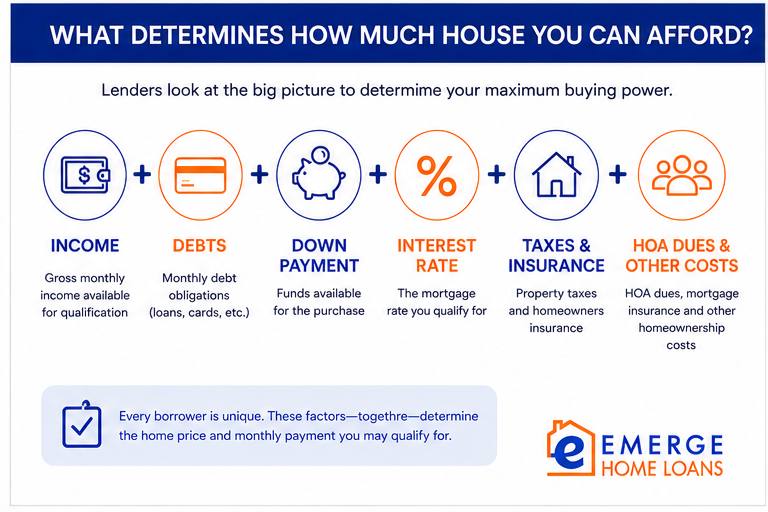
Your debts, down payment, credit profile, interest rate, property taxes, homeowners insurance, HOA dues, mortgage insurance, and loan program can all affect your purchasing power.
Two buyers earning exactly the same salary can qualify for very different home prices.
This guide explains how mortgage lenders calculate home affordability and, more importantly, how to determine a home-buying budget that makes sense for you.
Quick Answer: How Much House Can I Afford?
There is no single income-to-home-price formula that works for everyone.
Mortgage lenders generally determine your maximum purchasing power by evaluating:
Gross monthly income
Monthly debt obligations
Proposed housing payment
Down payment
Credit profile
Mortgage interest rate
Property taxes
Homeowners insurance
HOA dues, if applicable
Mortgage insurance, if applicable
The mortgage program you are using
A quick online calculator can provide an estimate, but an actual mortgage pre-approval provides a much more accurate picture of what you may be able to purchase.
And there is an important distinction:
The maximum amount you qualify to borrow isn't necessarily the amount you should spend.
A good home-buying budget considers both.
Start With Your Monthly Housing Payment — Not the Home Price
One of the biggest mistakes buyers make is focusing exclusively on the sales price.
Mortgage lenders are primarily concerned with the monthly housing expense created by that purchase.
Depending on the property and loan, your monthly housing expense may include:
Principal + Interest + Property Taxes + Homeowners Insurance + Mortgage Insurance + HOA Dues
This is sometimes referred to as PITI, although HOA dues and certain other expenses may also need to be included when qualifying.
That means two $600,000 homes can have substantially different monthly costs.
For example, one property could have:
No HOA
Lower property taxes
Lower homeowners insurance
Another could have:
$350 monthly HOA dues
Higher property taxes
Higher insurance costs
Even at the same purchase price, the second property could require significantly more monthly income to qualify.
California buyers should pay particular attention to property taxes and insurance.
These expenses can materially change affordability and should be estimated before deciding what price range to shop in.
What Is Debt-to-Income Ratio?
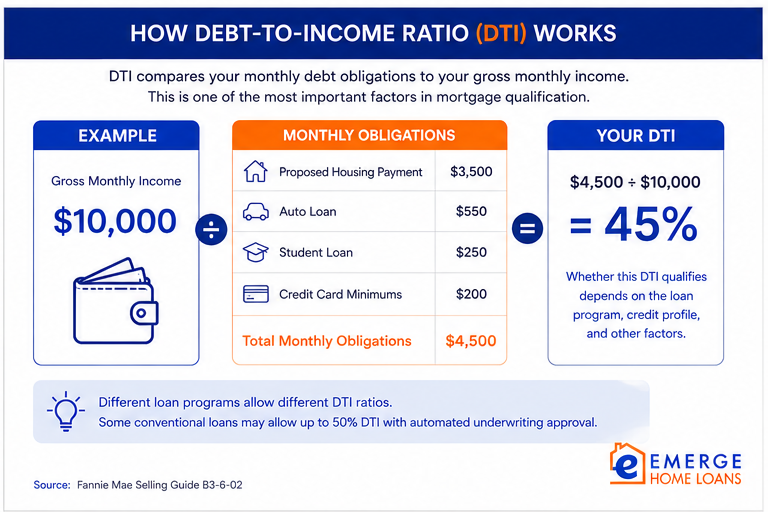
One of the most important numbers in mortgage qualification is your debt-to-income ratio, commonly called DTI.
DTI compares your qualifying monthly debt obligations with your gross monthly income.
The basic calculation is:
Total Monthly Debt ÷ Gross Monthly Income = Debt-to-Income Ratio
Example
Suppose you earn:
$10,000 per month before taxes
And your monthly obligations after purchasing the home would be:
Proposed housing payment: $3,500
Auto loan: $550
Student loan: $250
Credit card minimum payments: $200
Your total monthly obligations would be:
$4,500
Your DTI would therefore be:
$4,500 ÷ $10,000 = 45% DTI
Whether that DTI qualifies depends on the mortgage program, underwriting findings, credit profile, reserves, and other factors.
What DTI Do You Need to Buy a House?
There is a common misconception that every mortgage requires a DTI below 36% or 43%.
That's not necessarily true.
Different mortgage programs and underwriting systems allow different debt-to-income ratios.
For example, Fannie Mae's current Selling Guide permits Desktop Underwriter loan casefiles to have a maximum allowable DTI ratio of 50%, although that does not mean every borrower with a 50% DTI will qualify.
Other loan programs can have different requirements.
The important takeaway is:
Don't assume you don't qualify because an online affordability calculator says your debt-to-income ratio is too high.
Mortgage underwriting considers multiple factors, and an actual loan application can produce a different result.
How Much Income Do I Need to Buy a Home in California?
There isn't a reliable chart that says:
"$100,000 income = $500,000 house."
Here's why.
Consider two buyers who each earn $120,000 per year, or $10,000 per month before taxes.
Buyer A
$300 car payment
No credit card debt
No student loans
Larger down payment
Strong credit profile
Buyer B
$850 car payment
$400 credit card minimum payments
$500 student loan payment
Smaller down payment
Different credit profile
Their income is identical.
Their purchasing power isn't.
This is why calculating affordability based only on annual income can be misleading.
How Does Your Down Payment Affect What You Can Afford?
Your down payment affects affordability in several ways.
A larger down payment generally means:
A smaller loan amount
A lower monthly principal and interest payment
Potentially lower mortgage insurance costs
A lower loan-to-value ratio
But you do not necessarily need 20% down to purchase a home.
Depending on eligibility and the loan program, buyers may have options including:
Loan TypePotential Minimum Down Payment*ConventionalAs little as 3%FHAAs little as 3.5%VAPotentially 0%USDAPotentially 0%
*Eligibility requirements, loan limits, property requirements and other restrictions apply. Not every borrower will qualify for the minimum down payment shown.
Putting 20% down can eliminate private mortgage insurance on many conventional loans, but waiting until you've saved 20% isn't automatically the best strategy.
A mortgage professional can compare several down-payment scenarios and show you the estimated payment and cash required for each.
Don't Forget About Closing Costs
Your down payment isn't the only money you may need to purchase a home.
Buyers should also plan for closing costs and prepaid expenses.
These can include items such as:
Lender fees
Appraisal
Title and escrow charges
Recording charges
Prepaid property taxes
Homeowners insurance
Prepaid interest
Initial escrow account deposits
Freddie Mac advises buyers that closing costs can generally run approximately 2% to 5% of the purchase price, although the actual amount varies considerably by transaction.
Depending on the transaction and loan program, seller credits or other permitted credits may be available to help offset some closing costs.
How Much Does the Interest Rate Affect Buying Power?
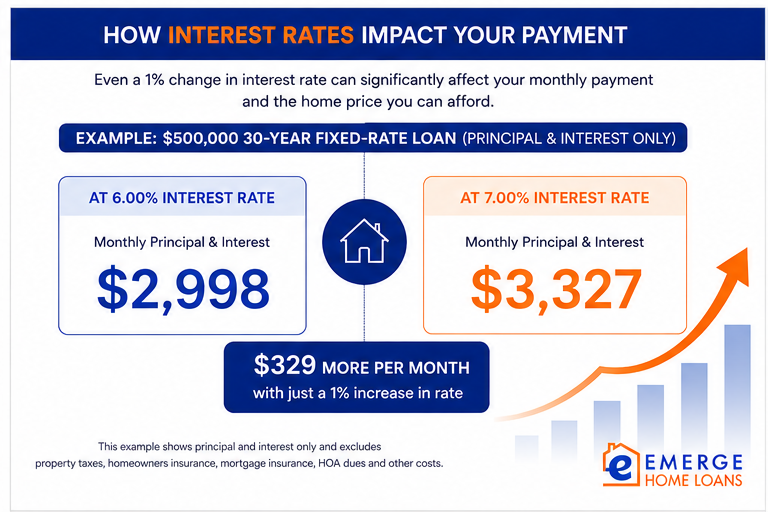
Interest rates can have a major effect on affordability.
Consider a hypothetical $500,000 30-year fixed-rate mortgage.
At a 6.0% interest rate, principal and interest would be approximately:
$2,998 per month
At 7.0%, it would be approximately:
$3,327 per month
That's roughly $329 more per month without changing the loan amount.
This illustrates why your maximum purchase price can change when mortgage rates move.
Important: These examples show principal and interest only and exclude taxes, insurance, mortgage insurance, HOA dues and other expenses.
What About Property Taxes in California?
Property taxes should be included when calculating your expected housing payment.
A common mistake is looking at what the current homeowner pays and assuming your taxes will be identical.
A California property purchase generally establishes a new base-year value for property tax purposes, subject to applicable California law. Additional local assessments can also affect the final tax bill.
For affordability planning, your mortgage professional should use a reasonable estimate of the taxes associated with your proposed purchase, rather than simply relying on the seller's current tax bill.
Homeowners Insurance Can Affect Your Qualification
Insurance has become an increasingly important part of buying a home in many California markets.
The premium depends on the property, insurer, location, coverage and other underwriting factors.
Because homeowners insurance is normally included in the qualifying housing expense, a higher premium can reduce purchasing power.
Before removing important contingencies or getting too far into a transaction, buyers should determine whether appropriate insurance is available and obtain a realistic estimate of its cost.
Should I Buy the Maximum Amount I'm Approved For?
Not necessarily.
There are really two affordability numbers every buyer should know:
1. Your Qualification Limit
This is the maximum loan and housing payment allowed under the applicable mortgage guidelines and underwriting results.
2. Your Comfort Limit
This is the payment that fits your actual lifestyle and financial goals.
Those numbers don't have to be the same.
For example, you may technically qualify for a $4,500 monthly housing expense but decide that $3,800 gives you more flexibility for:
Retirement savings
Travel
Childcare
Vehicles
Home maintenance
Emergency savings
Other financial goals
At Emerge Home Loans, we believe understanding both numbers is more useful than simply asking, "What's the biggest loan I can get?"
A Better Way to Determine Your Home-Buying Budget
Instead of starting with a random home price, work backward from the numbers.
Step 1: Determine Your Qualifying Income
Calculate the income that can actually be used for mortgage qualification.
This can be more complicated for buyers who are self-employed, commissioned, receive bonuses or overtime, own rental properties, or have variable income.
Step 2: Identify Your Monthly Debts
Review obligations such as:
Auto loans
Student loans
Credit cards
Personal loans
Alimony or child support when applicable
Other financed obligations
Step 3: Determine Available Funds
Identify how much cash you have available for:
Down payment
Closing costs
Reserves
Emergency savings
Don't automatically use every dollar you have for the purchase.
Step 4: Estimate the Complete Housing Payment
Include more than principal and interest.
Estimate:
Principal
Interest
Property taxes
Homeowners insurance
Mortgage insurance
HOA dues
Step 5: Compare Loan Options
Compare FHA, conventional, VA, USDA and other appropriate programs based on your circumstances.
The program requiring the smallest down payment isn't always the program with the lowest overall cost.
Step 6: Get Pre-Approved Before Shopping Seriously
A mortgage pre-approval gives you a much clearer idea of:
Your potential maximum purchase price
Estimated monthly payment
Cash needed to close
Appropriate loan programs
Potential qualification issues
It also allows you to shop for homes with a realistic price range.
Frequently Asked Questions
How much house can I afford on a $100,000 salary?
Salary alone isn't enough to accurately determine your maximum home price.
A lender also needs to consider your monthly debts, down payment, credit profile, mortgage rate, property taxes, insurance, HOA dues and loan program.
Two people earning $100,000 can therefore have very different purchasing power.
Do I need 20% down to buy a house in California?
No.
Some conventional mortgage programs allow eligible borrowers to purchase with as little as 3% down, while FHA financing can permit a minimum required investment of 3.5%. Eligible VA and USDA borrowers may have zero-down-payment options.
What is a good debt-to-income ratio for buying a house?
Lower DTI generally gives a borrower more financial flexibility, but there isn't one universal maximum DTI for every mortgage.
The allowable ratio depends on the loan program, underwriting method and borrower profile. Some conventional loans receiving automated underwriting approval may permit DTI ratios as high as 50%.
Does a car payment reduce how much house I can afford?
Usually, yes.
A qualifying monthly auto loan payment generally counts toward your debt-to-income ratio. A larger car payment can therefore reduce the housing payment you qualify for.
Does credit card debt affect home affordability?
Yes.
Mortgage underwriting generally includes required minimum monthly credit card payments when calculating your debt-to-income ratio.
Does an HOA affect mortgage qualification?
Yes.
Required HOA dues are generally included in the housing expense used for mortgage qualification. A home with substantial HOA dues may therefore require more income than a similarly priced home without an HOA.
Is an online mortgage calculator accurate?
An online calculator can be useful for an initial estimate, but it cannot fully evaluate mortgage eligibility.
Actual qualification can depend on income documentation, credit, debts, assets, loan guidelines, property characteristics and automated or manual underwriting.
Should I get pre-approved before looking at homes?
Generally, yes.
A pre-approval can help establish a realistic price range before you invest significant time touring properties or preparing an offer.
Find Out What You Can Actually Afford
Online calculators are a useful starting point.
But if you're seriously considering buying a home, the better question isn't:
"What does an online calculator say I can afford?"
It's:
"What can I qualify for, what will it actually cost me, and what payment am I comfortable with?"
Emerge Home Loans can evaluate your income, debts, down payment and goals and help you compare financing scenarios before you begin seriously shopping for a home.
Ready to find out your actual buying power?
Contact Emerge Home Loans to request a personalized home-buying analysis or start your mortgage pre-approval.
This article is for general informational purposes only and is not a commitment to lend. Loan approval, interest rates, loan amounts and terms are subject to credit approval, program guidelines, property eligibility and other underwriting requirements. Mortgage programs and guidelines are subject to change.